

Vanguard Vets LLC is a veteran-led consulting and digital support company dedicated to improving the transition experience for America’s Service Members, Veterans, and their families. We bring real military insight, mission-ready expertise, and modern digital strategy to help individuals and organizations navigate transition with clarity and confidence.

ABOUT US
Vanguard Vets proudly delivers two industry-leading solutions, MIND-SET and GO-180 designed to strengthen the transition journey for America’s Service Members.
GO-180 is designed to reduce friction, eliminate guesswork, and close transition gaps by delivering trusted resources, vetted partners, and AI-supported guidance tailored to each user’s stage of service and family needs.
Contact Us:
Name: Don Carter
Email: vanguardvets@vzent.com
Phone: (540) 232-9465
© 2025 Vanguard Vets LLC. All rights reserved.
GO-180™ and MIND-SET™ are trademarks of Vanguard Vets LLC.
All names, logos, content, and materials on this site are protected by applicable intellectual property laws. Unauthorized use is prohibited.

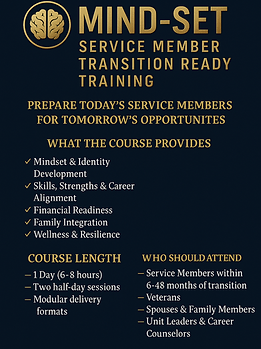
MIND-SET™ provides a mission-focused, instructor-led transition training experience built on proprietary instruction found only at Vanguard Vets. It equips Service Members with clarity, direction, and a personalized plan to navigate the shift into civilian life with confidence.

GO-180 is a secure, modular digital ecosystem that provides lifetime support for service members, veterans, and their families before, during, and after military transition. Through integrated, purpose-driven modules, GO-180 delivers access to employment pathways, financial and housing services, healthcare and insurance resources, education and entrepreneurship guidance, relocation and “Welcome Home” support, legal and benefits navigation, exclusive member discounts, and a private community network—all within one unified platform designed to reduce fragmentation, eliminate guesswork, and empower confident, successful transitions.
Terms & Conditions
A legal disclaimer
The explanations and information provided on this page are only general and high-level explanations and information on how to write your own document of Terms & Conditions. You should not rely on this article as legal advice or as recommendations regarding what you should actually do, because we cannot know in advance what are the specific terms you wish to establish between your business and your customers and visitors. We recommend that you seek legal advice to help you understand and to assist you in the creation of your own Terms & Conditions.
Terms & Conditions - the basics
Having said that, Terms and Conditions (“T&C”) are a set of legally binding terms defined by you, as the owner of this website. The T&C set forth the legal boundaries governing the activities of the website visitors, or your customers, while they visit or engage with this website. The T&C are meant to establish the legal relationship between the site visitors and you as the website owner.
T&C should be defined according to the specific needs and nature of each website. For example, a website offering products to customers in e-commerce transactions requires T&C that are different from the T&C of a website only providing information (like a blog, a landing page, and so on).
T&C provide you as the website owner the ability to protect yourself from potential legal exposure, but this may differ from jurisdiction to jurisdiction, so make sure to receive local legal advice if you are trying to protect yourself from legal exposure.
What to include in the T&C document
Generally speaking, T&C often address these types of issues: Who is allowed to use the website; the possible payment methods; a declaration that the website owner may change his or her offering in the future; the types of warranties the website owner gives his or her customers; a reference to issues of intellectual property or copyrights, where relevant; the website owner’s right to suspend or cancel a member’s account; and much, much more.
To learn more about this, check out our article “Creating a Terms and Conditions Policy”.